

Most drivers have been there. That triangle sign with two black arrows pointing opposite ways. But do you know what it means and what you’re meant to do when you see it? If you are studying for your theory test or want to be a safer driver, comprehending the two way traffic sign could actually prevent you from making a costly error on the road.
Here is the short answer: the two-way traffic sign indicates that the road ahead has traffic in both directions. You generally see it at the end of a one-way road or where a dual carriageway turns into a single lane. This signifies that oncoming cars are approaching right at you, and you need to rapidly change your road location, speed and alertness.
What Does the Two Way Traffic Sign Mean?
The two way traffic sign tells you that vehicles are traveling in both directions on the road ahead. It appears at the point where a one-way system transitions into a bidirectional route, warning you to prepare for oncoming traffic. You must stay in your lane, check mirrors, and reduce speed if necessary.
Think of it as the road’s way of saying, “heads up, it’s not just you out here anymore.” When you’ve been driving on a one-way road, you naturally stop scanning for oncoming vehicles. This sign snaps you back to full awareness before you reach that two-way section.
It’s not a suggestion. It’s a warning, and like all warning road signs UK roads use, it demands a response.
Two Way Traffic Symbol: Shape, Colour, and Design
In the UK, the two-way traffic sign is triangular, with a white background and red border. It has two black vertical arrows, one pointing up and one pointing down. It’s readily recognised in the standard Highway Code warning sign format.
This is one place where many learners get mixed up. In the USA, the sign is diamond-shaped with a yellow background (under MUTCD regulations, it is designated W6-3). It’s the shape of all warning signs in the Highway Code in the UK, a red-bordered triangle.
Road sign shapes and colours UK drivers need to know:
- Triangle with red border = warning sign (hazard ahead)
- Circle with red border = prohibitory sign (gives orders)
- Rectangle = information or direction sign
- Blue circle = positive instruction (e.g., turn left)
The two way traffic sign sits firmly in the warning category. That triangular shape tells you something requires your attention before you reach it.
Two Types of Two Way Traffic Signs You Must Know
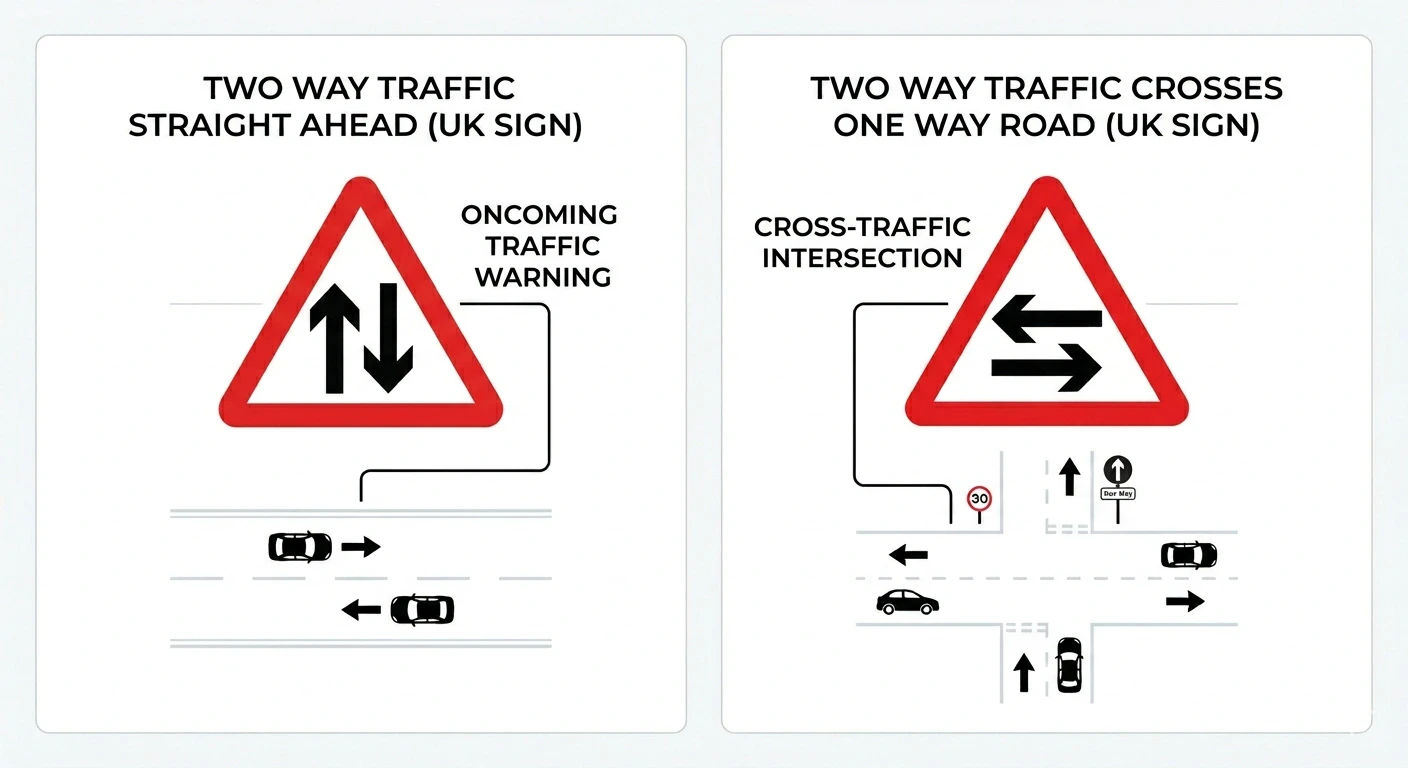
We must distinguish between the two distinct configurations used on our roads. Mixing them up causes dangerous errors during the driving theory test and practical examinations.
1. Two-Way Traffic Straight Ahead
This layout features vertical arrows, with the left arrow pointing up and the right arrow pointing down. It sits directly on your route to show that your current one-way street or dual carriageway is transitioning into a standard two-way street.
2. Two-Way Traffic Crosses a One-Way Road
This configuration uses horizontal arrows pointing left and right. It warns drivers traveling on a one-way street that the crossroad junction directly ahead carries traffic moving in both directions, altering how you must position your vehicle to turn.
Purpose of the Two Way Traffic Sign
Road signs don’t exist to fill up space. Each one serves a specific safety function. Here’s why the two way traffic sign matters:
Prevents head-on collisions. On roads without a centre line, drivers can drift into the wrong side. A clear warning gives you time to adjust position before it becomes dangerous.
Manages lane discipline. When you know two-way traffic is ahead, you naturally stay left. This keeps traffic flowing safely without confusion.
Supports hazard awareness. Early warning means early reaction. You have more time to check mirrors, adjust speed, and plan your approach rather than reacting at the last second.
Protects pedestrians too. At junctions where one-way roads meet two-way roads, pedestrians often misjudge traffic direction. The sign prompts all road users, including walkers, to stay alert.
Where Is the Two Way Traffic Sign Posted?
We regularly encounter these markers at locations where the structural flow of traffic alters permanently or temporarily. Engineers place them at specific distances before the hazard to ensure drivers have adequate processing time.
End of One-Way Streets
The signs appear at the terminal boundary of urban one-way systems. They ensure you do not remain positioned in the right-hand lane when entering the bidirectional section.
Dual Carriageway Transitions
You will see this marker where a divided highway terminates, causing traffic from both directions to share a single, undivided surface. This layout change is often accompanied by a dual carriageway ends sign.
Temporary Road Works
Construction crews deploy these temporary markers during lane closures or detours. They indicate that a single side of the highway is temporarily carrying a bidirectional traffic warning stream.
Two Way Sign vs One Way Sign: Key Differences
| Feature | Two Way Traffic Sign | One Way Sign |
| Shape | Triangle (UK) | Rectangle |
| Colour | White with red border | White with black arrow |
| Meaning | Traffic moves in both directions | Traffic moves in one direction only |
| Purpose | Warning sign | Information/direction sign |
| Location | End of one-way roads, dual carriageway merges | Entrance to one-way streets |
| Driver action | Stay left, check mirrors, adjust speed | Follow the permitted direction |
The key distinction is intent. The one-way sign guides you. The two way traffic sign warns you. One tells you what to do; the other tells you what to expect.
Can You Overtake on a Two-Way Road?
Yes, you can overtake on a two-way road, but only when it is safe and legal to do so. You must check for oncoming traffic, assess road markings, and have a clear view of the road ahead. Overtaking on bends, near junctions, or at pedestrian crossing signs is dangerous and often illegal.
Here’s how to approach overtaking safely on a two-way road:
Check road markings first. A solid white centre line means no overtaking. A broken white line means overtaking is permitted if it’s safe. Never cross a solid line.
Use the MSM routine (Mirror-Signal-Manoeuvre). Check your mirrors, signal your intention, and only manoeuvre when you have a clear, safe gap.
Consider your speed. If you’re approaching a school zone sign, crosswalk sign, or pedestrian crossing sign, do not attempt to overtake. These areas carry a higher risk of sudden stops.
Never overtake near a do not enter sign or a dead end sign. These indicate restricted or limited road space ahead, making overtaking extremely risky.
Mirror Checking When You See a Two Way Traffic Sign

Using your mirrors correctly when transitioning to a bidirectional layout ensures you remain aware of adjacent road users. We use the official MSPSL routine to manage this change safely.
1.Mirror Assessment:Look Behind First.
Check your interior rear-view mirror followed by your side mirrors to calculate the speed and positioning of following vehicles before changing pace.
2.Signal Intent:Inform Other Road Users.
Apply your indicators early if you intend to alter your course or move back to the left lane after exiting a one-way system.
3.Position Adjustment:Establish Lane Discipline.
Guide your vehicle smoothly to the left side of the single carriageway, leaving sufficient space for oncoming traffic.
4.Speed Regulation:Match the New Hazard.
Ease off the accelerator or apply gentle braking to match the lower visibility and tight spaces of the upcoming road layout.
5.Look for Hazards:Final Observation.
Scrutinise the road ahead for wider oncoming vehicles, cyclists, or hidden bends before finalizing your position.
Two Way Traffic Sign on Your Driving Theory Test
Using your mirrors correctly when transitioning to a bidirectional layout ensures you remain aware of adjacent road users. We use the official MSPSL routine to manage this change safely.
1.Mirror Assessment:Look Behind First.
Check your interior rear-view mirror followed by your side mirrors to calculate the speed and positioning of following vehicles before changing pace.
2.Signal Intent:Inform Other Road Users.
Apply your indicators early if you intend to alter your course or move back to the left lane after exiting a one-way system.
3.Position Adjustment:Establish Lane Discipline.
Guide your vehicle smoothly to the left side of the single carriageway, leaving sufficient space for oncoming traffic.
4.Speed Regulation:Match the New Hazard.
Ease off the accelerator or apply gentle braking to match the lower visibility and tight spaces of the upcoming road layout.
5.Look for Hazards:Final Observation.
Scrutinise the road ahead for wider oncoming vehicles, cyclists, or hidden bends before finalizing your position.
Road Markings After a Two Way Traffic Sign
The two way traffic sign and road markings work together to advise your behaviour on a two way route. A solid white centre line signifies no crossing. Broken line signifies can overtake if safe. Roadside yellow lines indicate parking restrictions.
Here’s a quick breakdown of what to look for:
Solid white centre line – This is a hard boundary. Do not cross it. It exists because visibility or road width makes crossing dangerous.
Broken white centre line – Crossing is permitted when safe. You can overtake if you have clear visibility and no oncoming traffic.
Double white lines – If the line nearest to you is solid, do not cross. If it’s broken, you may cross if safe. These often appear before bends or at the brow of hills.
No centre line at all – Treat the middle of the road as the boundary. Stay left. Drive at a speed that allows you to stop within the distance you can see to be clear.
Road markings and the oncoming traffic sign work as a system, not in isolation. Read both together to build a full picture of what the road expects from you.
Learn Road Signs with Pharez Driving School
Understanding road signs is one thing. Applying them confidently in real traffic is another. At Pharez Driving School, our instructors teach you how to read road signs within the flow of real driving, not just for the theory test.
Whether you’re working toward your first test or brushing up on highway code road signs before a retest, our lessons are built around what the DVSA actually looks for. We cover everything from warning signs and railroad crossing signs to speed limit signs, stop signs, and all traffic signs covered in the Highway Code.
Check out our Pricing Packages to find the lesson plan that fits your schedule and budget. We offer flexible options for complete beginners right through to test-ready drivers.
Contact us today to book your first lesson and take the guesswork out of your driving test preparation.
Frequently Asked Questions
What is a two way traffic sign?
The two way traffic sign is a UK warning sign that alerts drivers to bidirectional traffic ahead. It’s triangular with a white background, red border, and two black arrows pointing in opposite directions. It appears where a one-way road ends or where a dual carriageway merges into a single carriageway.
What road sign means two way traffic?
In the UK, the triangular red-bordered sign with two vertical black arrows is the official Highway Code sign for two-way traffic. It belongs to the warning sign category, which covers all hazards and changes in road conditions that drivers need to be aware of in advance.
What does the two way traffic sign mean?
It means the road ahead carries traffic in both directions. You must adjust your road position, check mirrors, reduce speed if needed, and stay on the left side of the road. This sign marks a transition point where your driving behaviour needs to change.
What is the road sign for two way traffic?
The UK road sign for two-way traffic is a white triangle with a red border containing two black arrows, one pointing up and one pointing down. It’s a warning sign under the Highway Code and is placed before sections of road where oncoming vehicles will be present.
What does “2 way road” mean?
A two-way road is any road where vehicles travel in both directions. Unlike a one-way street where all traffic moves the same way, a two-way road has oncoming vehicles. Most UK roads are two-way. The sign appears specifically where this might not be expected, such as after a one-way system.
