

Most drivers know not to drink and drive.” But the real question that catches folks out is how many units to drive before you are above the limit? Honestly, there isn’t one figure that fits everyone, and that’s precisely what makes drinking and driving so dangerous. How alcohol affects you depends on your physiology, your weight, what you last ate and even how stressed you are.
So the quick answer here is that there is no safe number of units that will definitely keep you under the UK drink-drive limit. The legal limit in England, Wales and Northern Ireland is 80mg of alcohol per 100ml of blood (35mg per 100ml of breath). It falls to 50mg per 100 mL of blood. A pint of normal beer contains about 2.3 units, which, for many people, is enough to put them dangerously close to the limit.
How Alcohol Affects Driving

Alcohol is a central nervous system depressant, which means it decreases your brain functioning nearly instantaneously. The second alcohol enters your bloodstream, it starts interfering with the neurological pathways for split-second decisions. It takes longer for your eyes to convey clear visual information to your brain, so it is tougher to see threats.
“It’s really hard to deal with what happens on the road. Your brain finally senses a threat. The motor commands sent to muscles are delayed. This lag time results in reduced reaction times, which means your stopping distance increases substantially.
Alcohol not only slows you physically, but it also clouds your judgement and strips you of your natural inhibitions. You are significantly more likely to take risky chances, like speeding or running red lights, without even realising the danger. Your attention level is too low, and you are unable to monitor multiple road components simultaneously (pedestrians, traffic lights, nearby traffic, etc.).
The Law and Drink Driving Alcohol Limits in the UK

The UK has different legal drink drive limits depending on where you are in the country.
In England, Wales and Northern Ireland:
| Measure | Legal Limit |
| Blood | 80mg per 100ml |
| Breath | 35mg per 100ml |
| Urine | 107mg per 100ml |
In Scotland, the limits are stricter:
| Measure | Legal Limit |
| Blood | 50mg per 100ml |
| Breath | 22mg per 100ml |
| Urine | 67mg per 100ml |
Scotland reduced its limit in 2014, bringing it closer to most of mainland Europe. England, Wales and Northern Ireland remain among the more lenient in Europe though the legal limit is still strict enough to catch out people who think “just one or two” is fine.
It’s also worth knowing: the law doesn’t only apply to drivers. If you’re sitting in the driver’s seat with the keys and intent to drive while above the limit, that counts as being “in charge of a vehicle.” You can be charged without having moved an inch.
How Much Can I Drink and Stay Under the Limit?
You cannot drink any specific amount of alcohol and guarantee you will stay under the legal limit. Your body processes alcohol based on highly variable factors like your weight, biological sex, age, and metabolic rate. What constitutes a safe amount for one person can easily put another over the limit.
Because of this physiological variance, tracking units of alcohol and driving is an unreliable survival strategy. A unit is technically defined as 10ml or 8g of pure alcohol, but knowing this definition does not tell you what your breathalyser reading will be. Your current stress levels, when you last ate, and how tired you are all change how quickly your liver processes the toxin.
If you are going out, the best option is to plan ahead. Choose a designated driver who agrees to stay completely alcohol-free for the night. Alternatively, rely on public transport or pre-booked taxis to ensure you never have to guess your blood-alcohol level.
How Many Pints Can You Drink and Drive?
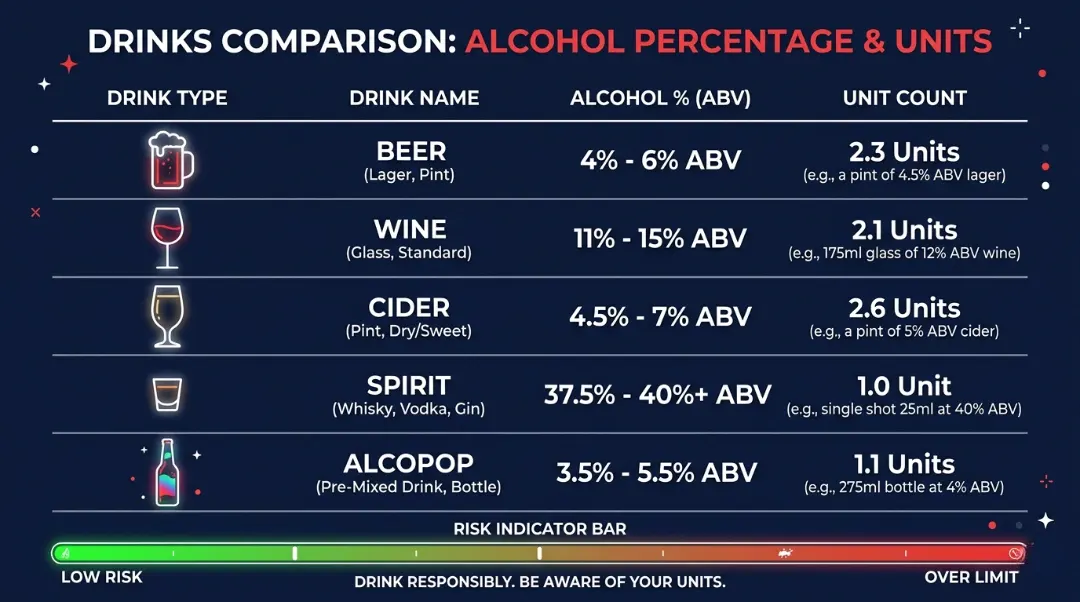
Most people will be over the legal limit after two pints of standard lager. A single pint of 4% lager contains roughly 2.3 units. Two pints puts you at around 4.6 units and for an average adult, that’s likely above the 80mg blood alcohol threshold in England and Wales.
But “average adult” covers a massive range. A lighter person or someone who hasn’t eaten will reach the legal limit faster. A heavier person who ate a large meal may process alcohol more slowly. There’s no formula that removes the risk.
Here’s a breakdown by drink type:
| Drink | Approx. Units |
| Pint of lager (4%) | 2.3 units |
| Pint of strong lager (5.2%) | 3 units |
| Pint of cider (4.5%) | 2.6 units |
| Large glass of wine (250ml, 13%) | 3.3 units |
| Standard glass of wine (175ml, 12%) | 2.1 units |
| Single spirit (25ml, 40%) | 1 unit |
| Bottle of alcopop (330ml, 4%) | 1.3 units |
Even one pint of strong lager (3 units) is enough to push many people close to or over the limit, particularly if they weigh less than average or haven’t eaten.
The short version: don’t try to calculate. The only zero-risk choice is zero alcohol before driving.
How Many Glasses of Wine to Drive?
Two ordinary glasses of wine (175ml at 12%) are around 4.2 units. For most people, that’s above the legal driving limit in England and Wales – and considerably above the limit in Scotland.
The intensity of wine can vary greatly. A bottle of 13% has more units per glass than a bottle of 11%. Restaurant pours are generally 250ml rather than 175ml, pushing a single glass past 3 units. When drinking wine, people tend to underestimate the amount they have drunk.
If you are expecting to drive later in the evening, one tiny glass at the beginning of the night provides your body some time to clear out the alcohol. But two or more glasses, especially with the higher alcohol levels, makes driving the same evening a real risk.
How Many Units Over the Limit Are You if You Drink Casually?
Even the occasional drinker often finds himself above the legal limit without knowing it. One business function with two glasses of wine and a beer is about 7-8 units. Your body takes around an hour to metabolise a unit. You could have four to five units lingering in your system when you get behind the wheel after a 3-hour event.
That’s also why the “morning after” problem is so widespread. If you drink extensively in the evening, you could be above the legal limit the next morning, especially if you drive to work early. This is sometimes a surprise to many drivers, which is why alcohol-related driving sanctions apply to early-morning commuters.
How Would I Be Tested for Drinking Driving?
Police can stop any vehicle at any time. They don’t need a reason. If they suspect alcohol, they can breathalyse you on the spot using a roadside device. You can also be tested after a traffic offence or an accident.
If the roadside breath test registers a fail (or if there are grounds for suspicion beyond the test), you’ll be taken to a police station for a second, more accurate test. Two breath samples are taken. The lower of the two readings is used to determine whether you’re over the limit.
In some cases for example, if there are medical reasons a breath test can’t be used police can require a blood or urine sample instead. Refusing to provide a sample is itself a criminal offence, even if you’re below the limit.
The legal limit for a positive roadside breath test is 35 micrograms of alcohol per 100ml of breath in England and Wales, and 22 micrograms in Scotland.
What’s the Punishment if You’re Caught Drink Driving?

A conviction for driving while above the legal alcohol limit carries a mandatory minimum 12-month driving disqualification, an unlimited fine, and up to six months in prison. The exact penalties scale heavily based on the severity of the reading.
+———————————————————————–+
| OFFICIAL UK DRINK DRIVING PENALTIES |
+———————————————————————–+
| OFFENCE | FINE | PRISON TERM | DRIVING BAN|
+—————————-+—————-+————-+————+
| Being in charge of a car | Up to £2,500 | Up to 3 mos | Possible |
| Driving or attempting it | Unlimited | Up to 6 mos | Min 1 year |
| Refusing to give a sample | Unlimited | Up to 6 mos | Min 1 year |
| Causing death by driving | Unlimited | Life term | Min 5 years|
+—————————-+—————-+————-+————+
Refusing to provide a specimen of breath, blood, or urine at the police station is a separate criminal offence. It carries the exact same weight as a failed test, ensuring drivers cannot avoid disqualification by simply refusing to cooperate.
The consequences stretch far into your personal life. A conviction creates a permanent criminal record, which can cause job loss and prevent entry to countries like the USA. Future car insurance premiums will skyrocket, often becoming completely unaffordable for several years.
How Long Does Drink Driving Stay on Your Licence and Record?
A drink driving conviction stays on your licence for 11 years from the date of conviction. Under the Rehabilitation of Offenders Act 1974, the conviction is considered “spent” after 5 years but the DVLA endorsement on your licence remains for the full 11 years.
This matters because insurers can see those endorsements. Even after the 5-year spent period, renewal applications, certain jobs, and professional driving roles may still surface the conviction depending on the disclosure requirements.
If you drive for work or hold a vocational licence (such as an HGV or PSV), a drink driving conviction carries additional consequences and may result in your vocational licence being revoked separately from your standard driving licence.
When Did Drink Driving Become Illegal in the UK?
Drink driving has been illegal in the UK since 1872, when the Licensing Act made it an offence to be drunk in charge of a vehicle including horses and carriages. The fine was 40 shillings, which equals roughly £240 today.
The modern framework came into shape through a series of changes:
- 1925 Criminal Justice Act extended the law to mechanically-propelled vehicles
- 1930 Updated to cover driving while under the influence to the point of losing proper control
- 1965 A specific blood alcohol limit was introduced for the first time
- 1967 Breath testing was introduced and enforcement became practical
- 2014 Scotland lowered its limit from 80mg to 50mg per 100ml blood
The 1967 introduction of the breathalyser was the turning point. Before that, proving impairment relied on an officer’s subjective assessment. The breathalyser made enforcement objective, measurable, and far more consistent.
Guide to the Drink Drive Limit in the UK: What You Need to Know
The UK drink drive limit is set high enough that many drivers assume they can have a drink or two and still be legal. That assumption is the root cause of thousands of accidents each year.
Here’s what matters most:
The legal limit doesn’t equal a “safe” limit.
Even below the threshold, alcohol affects reaction times, judgement, and hazard perception. You can be impaired and still technically legal. The police advice is consistent: zero alcohol if you’re driving.
Units are a guide, not a formula.
Tracking how many units of alcohol you’ve consumed helps you monitor intake, but it doesn’t tell you your precise blood alcohol level. Your weight, what you’ve eaten, and how quickly you metabolise alcohol are all variables that affect the outcome.
The morning after is a real risk.
A heavy night out can leave alcohol in your system well into the next day. If you drank until midnight and had 8 to 10 units, you may still be over the limit at 8am. Use a drinks calculator or simply don’t drive if you’re unsure.
Tips to Change Your Relationship With Alcohol Before Driving
If you find yourself regularly calculating how many units to drive under the limit, it might be worth stepping back to look at the habit itself. Here are some practical approaches:
Plan before you go out. Decide in advance whether you’re driving. If you are, commit to it before the first drink arrives. Decisions made in advance are far more reliable than ones made mid-evening.
Designate a driver. Rotating who stays alcohol-free within a group takes the pressure off any one person regularly.
Use alcohol-free alternatives. The quality and variety of low-alcohol and alcohol-free drinks has improved significantly. Many pubs and restaurants now carry convincing alternatives.
Know your numbers. Use the NHS unit calculator to track what you drink across a week. The recommended limit is 14 units per week with alcohol-free days in between. Staying well within that range during a typical week also reduces the risk of creeping above it on a night you’re driving.
If you’re unsure don’t drive. That’s the only advice that removes risk entirely.
Final Thoughts
Drink driving isn’t just a legal risk it’s one of the most preventable causes of road deaths in the UK. An estimated 6,800 people were killed or injured in drink drive accidents in Great Britain in 2022 alone. The question of how many units to drive under the limit has one honest answer: there isn’t a number that’s reliably safe for everyone.
If you’re learning to drive and building good habits from the start, understanding the law around alcohol is part of becoming a responsible driver. At Pharez Driving School, we help learners not just pass their test, but actually understand how to drive safely for life.
If you’d like to know more about lesson structures, costs, or how to get started, contact us here we’re straightforward and happy to help.
FAQs
Is it illegal to drive the morning after drinking?
Yes, if you’re still above the legal limit. Alcohol doesn’t clear your system by morning automatically it clears at roughly one unit per hour. If you drank heavily the night before, you may still be over the limit for your morning commute.
How many units is the drink drive limit?
There’s no unit-based drink drive limit. The legal limits are set in blood, breath, and urine measurements. Units help you track what you drink but don’t directly translate to a blood alcohol reading, because every person processes alcohol differently.
What is the legal limit for alcohol when driving?
In England, Wales and Northern Ireland: 80mg per 100ml of blood, 35mg per 100ml of breath. In Scotland: 50mg per 100ml of blood, 22mg per 100ml of breath.
How many ciders to get drunk and be over the limit?
Two pints of standard cider (4.5%) equals roughly 5.2 units. For most people, that’s above the drink drive limit in England and Wales. Strong ciders (6–7%) bring the number down to around one and a half pints before the average person exceeds the threshold.
Can you drive with any alcohol in your system?
Technically yes, in small amounts, if you’re under the legal limit. But the legal limit isn’t a safe limit. Even trace amounts of alcohol slow your reaction time and reduce hazard perception. Zero alcohol before driving remains the safest choice.
What are the legal units to drive in Scotland?
Scotland doesn’t set limits in units. Its blood alcohol limit is 50mg per 100ml stricter than the rest of the UK. In practice, this means even one to two drinks could put some people over the limit in Scotland.
